
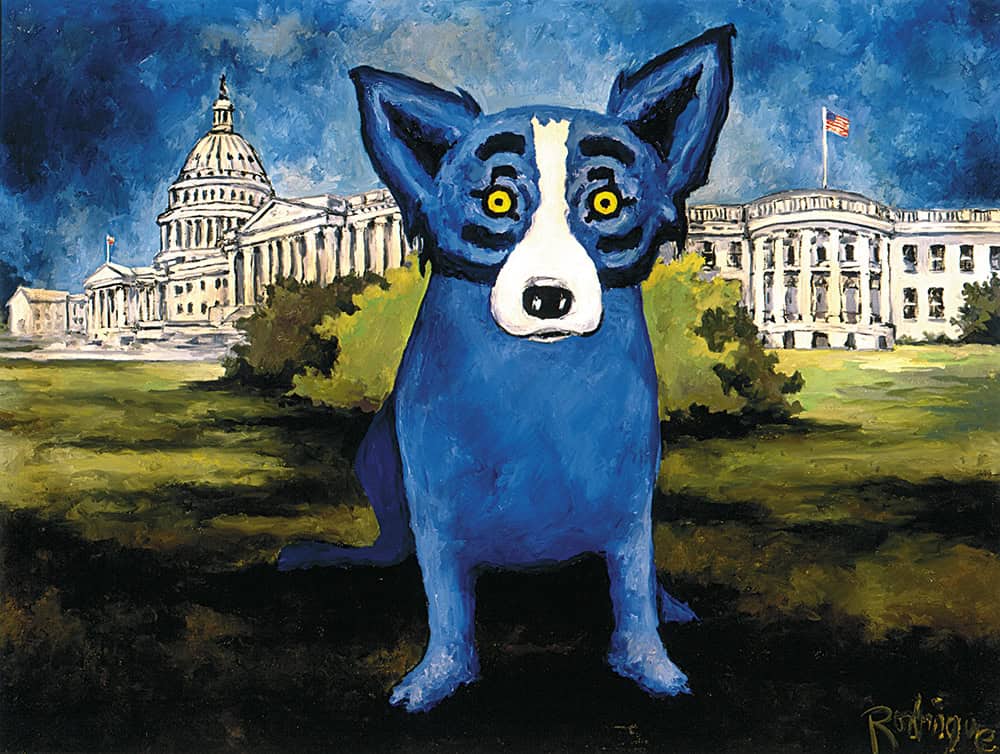
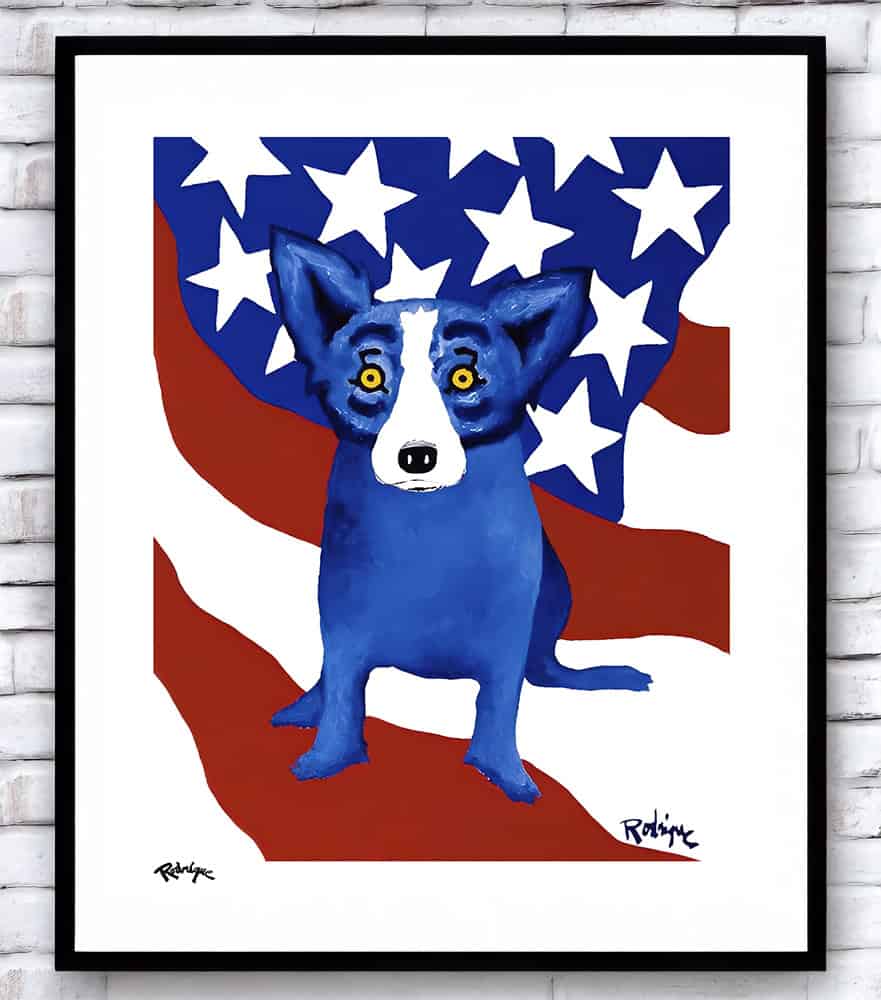
Washington Blue Dog, 1993, oil on canvas, 30 x 40 inches
 As the United States celebrates its 250th anniversary, the paintings of George Rodrigue offer a distinctive perspective on American identity. Born and raised in southwest Louisiana, Rodrigue spent much of his career interpreting the landscapes, people, and traditions of Acadiana before expanding his vision to engage broader national themes. His work consistently bridges regional heritage with a wider sense of belonging, moving from the preservation of Cajun culture to the creation of icons that speak to American ideals of resilience, reinvention, and inclusion.
One of the most persistent misconceptions about George Rodrigue is that he was a self-taught folk or outsider artist because he painted Louisiana subjects and later created the deceptively simple Blue Dog. In fact, he received rigorous formal training, first studying art at the University of Southwestern Louisiana (now the University of Louisiana at Lafayette) before continuing at the ArtCenter College of Design in Los Angeles, California. There he immersed himself in drawing, design, composition, and the principles of modern visual communication while studying alongside artists preparing for careers in fine art and commercial illustration. Rather than rejecting his academic training, Rodrigue built upon it, deliberately developing a visual language uniquely his own—one rooted in Louisiana but informed by modernism, Pop Art, and contemporary design. This foundation would allow him to transform regional subject matter into imagery that resonated far beyond Louisiana, ultimately becoming part of the broader story of American art.
Before the Blue Dog became widely known, Rodrigue focused on preserving what he saw as an eroding Cajun heritage. In his 1976 book, The Cajuns of George Rodrigue, the first nationally published volume on the subject, he presented one hundred paintings accompanied by descriptions in English and French. The book received recognition from the National Endowment for the Arts and was designated an official Gift of State during the Carter administration.

The Class, 1972, Oil on canvas, 36 x 27 inches
Rodrigue frequently returned to the motif of the American flag in these early works. Explaining one of his key paintings, The Class of Marie Courregé (based on a 1926 photograph of his mother’s school class), he stated:
“Marie Courregé is my mother. [bottom row, third from right] I show her with her school class to show the unity of the Cajuns, their determination to go forward, their desire to embrace the flag of America.”
In the same volume he elaborated on this theme:
“I have a series of paintings showing the American flag to reveal the strong national pride of the Cajun. He wanted to be a part of something; he wanted a country; he wanted to be an American.”
These statements reflect Rodrigue’s view of Cajun culture not as isolated, but as an integral thread within the larger American fabric. Paintings such as Louisiana Cowboys (1988) further illustrate this synthesis, placing figures rooted in Louisiana tradition within compositions that evoke classic American narratives of independence and frontier life, all rendered beneath the sweeping live oaks that became a signature element of his style.
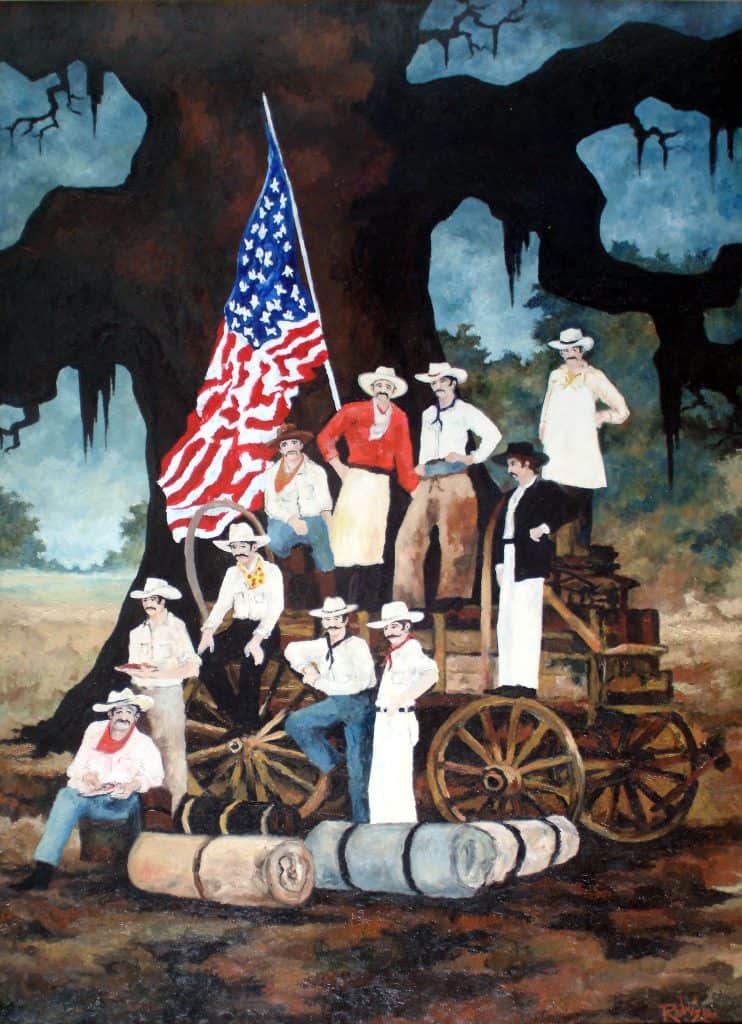
Louisiana Cowboys, 1987, oil on canvas, 110 x 86 inches
In choosing to focus his efforts on Cajun subjects for more than two decades, Rodrigue consciously aligned himself with the American Regionalist tradition exemplified by artists such as Grant Wood, Thomas Hart Benton, and Andrew Wyeth. Like those artists, he understood that deeply local stories could reveal universal truths about American life.
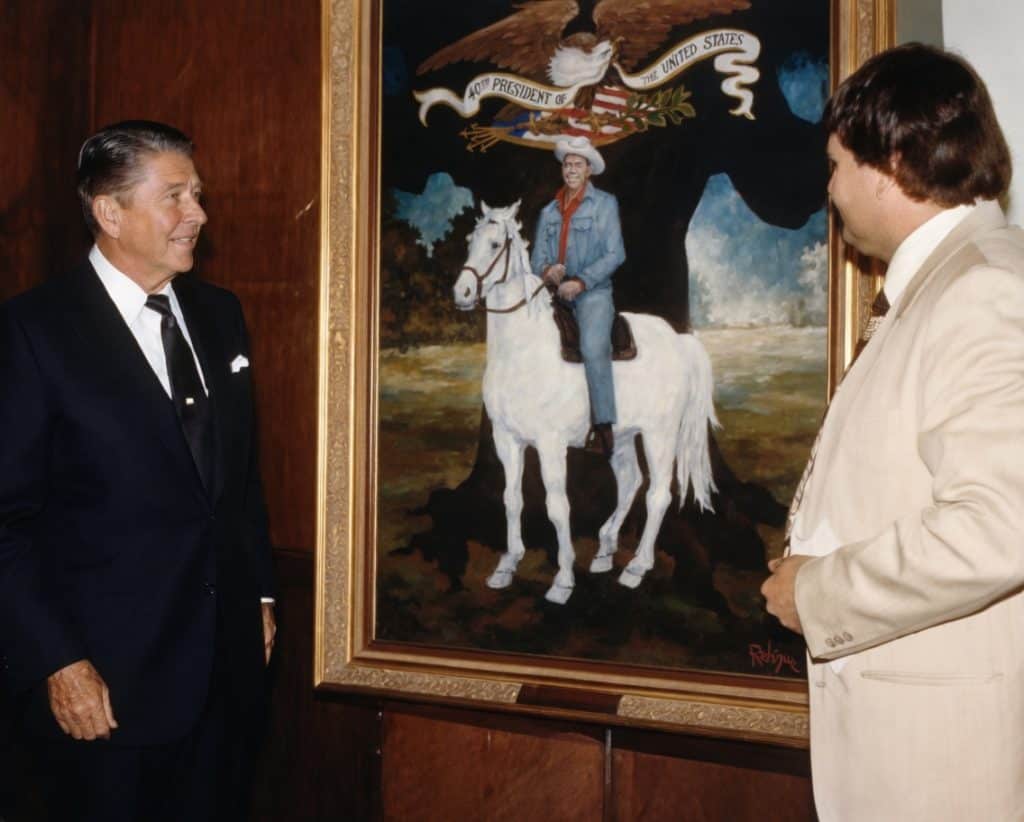
Rodrigue’s reputation as a portraitist led to commissions from both major political parties. In 1986 the Republican National Committee commissioned An American Hero, a portrait of President Ronald Reagan. Rodrigue approached the subject in his established Cajun style, incorporating the live-oak motif and narrative elements that characterized his earlier Louisiana work. He personally presented the painting to the President during ceremonies in New Orleans and Baton Rouge.
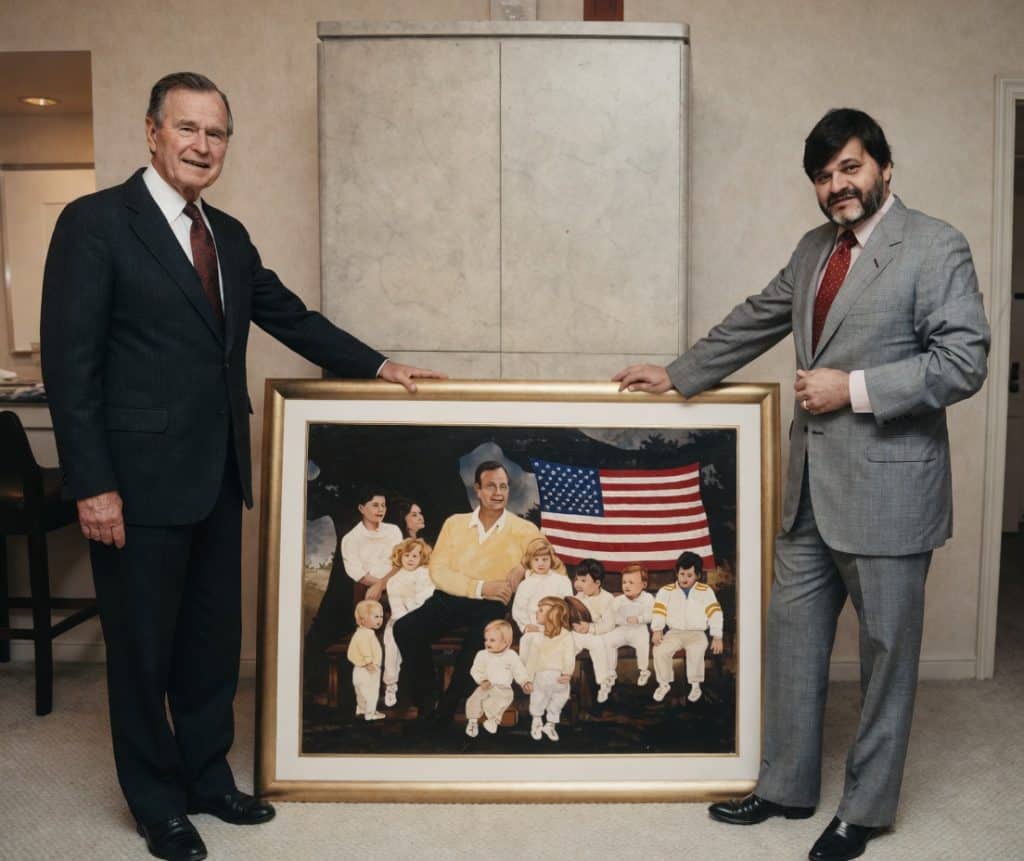
Two years later, in 1988, he painted Portrait of George H.W. Bush and His Grandchildren, again commissioned by the Republican Party. The work hung in the White House throughout the Bush presidency and was presented directly to the former President.
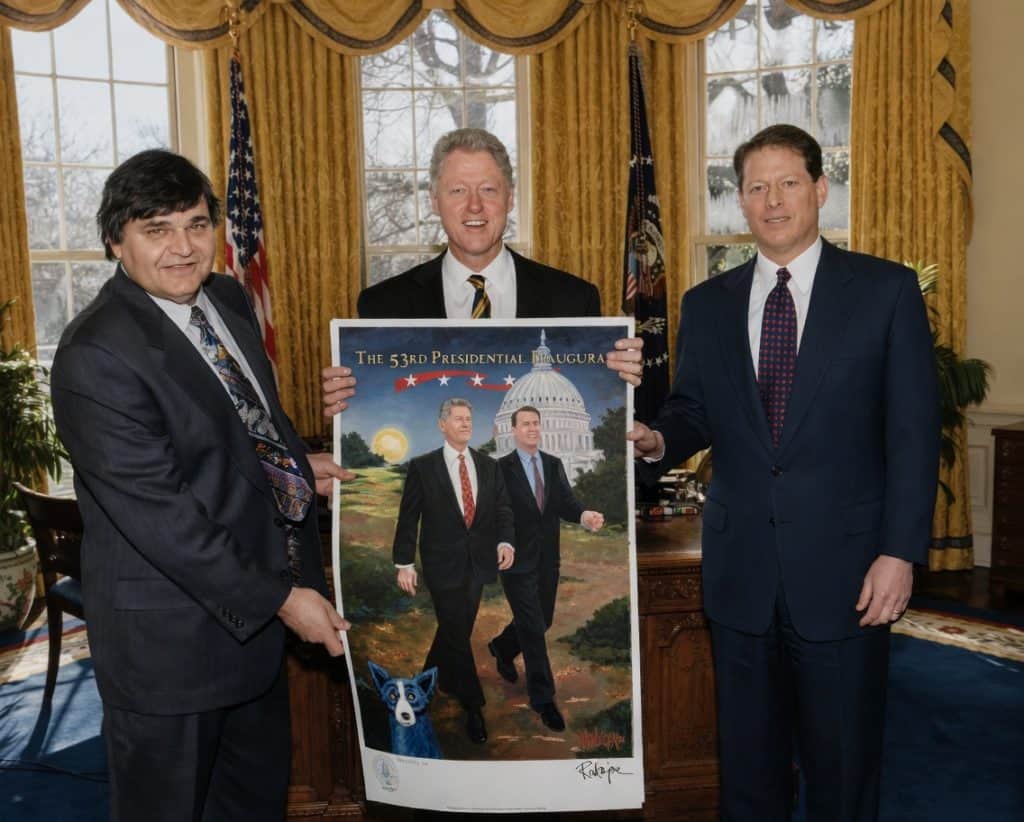
By 1997, the Democratic National Committee commissioned the official print for the 53rd Presidential Inaugural, Walking Into the 21st Century, featuring President Bill Clinton and Vice President Al Gore. President Clinton personally requested that the Blue Dog appear in the composition. This inclusion marked a turning point: what had begun as a figure drawn from Cajun folklore had become a recognized element of national iconography.
The Blue Dog did not represent a departure from Rodrigue’s earlier work, but rather its distillation. The themes that had long defined his Cajun paintings—place, memory, folklore, identity, and belonging—became concentrated into a single unforgettable figure. The series originated in the early 1980s from the Cajun loup-garou legend, first appearing in a painting titled Watchdog created for a book of Louisiana ghost stories. By the early 1990s, Rodrigue had stripped away the landscape and folkloric trappings, transforming the figure through the bold, hard-edge graphic language of Pop Art. Its apparent simplicity was not the product of artistic naïveté, but the result of decades of refinement by a classically trained painter seeking the most direct and universal visual expression. Just as Andy Warhol elevated Campbell’s Soup Cans into emblems of American consumer culture, Rodrigue distilled the Blue Dog into a simplified silhouette with piercing yellow eyes and electric, saturated color.
What began as a local legend became something larger: a versatile symbol capable of commenting on contemporary life. Its steady gaze—carrying the hopes and longings of a melancholy people yet always looking forward—invites viewers to confront their own questions about belonging, loss, and resilience. Over time, the figure moved beyond its folkloric roots into patriotic compositions featuring strong red, white, and blue palettes. Works such as the 1993 Washington Blue Dog (pictured above), which depicts the U.S. Capitol and White House, positioned the character as a tribute to the principles and institutions that have shaped national life.
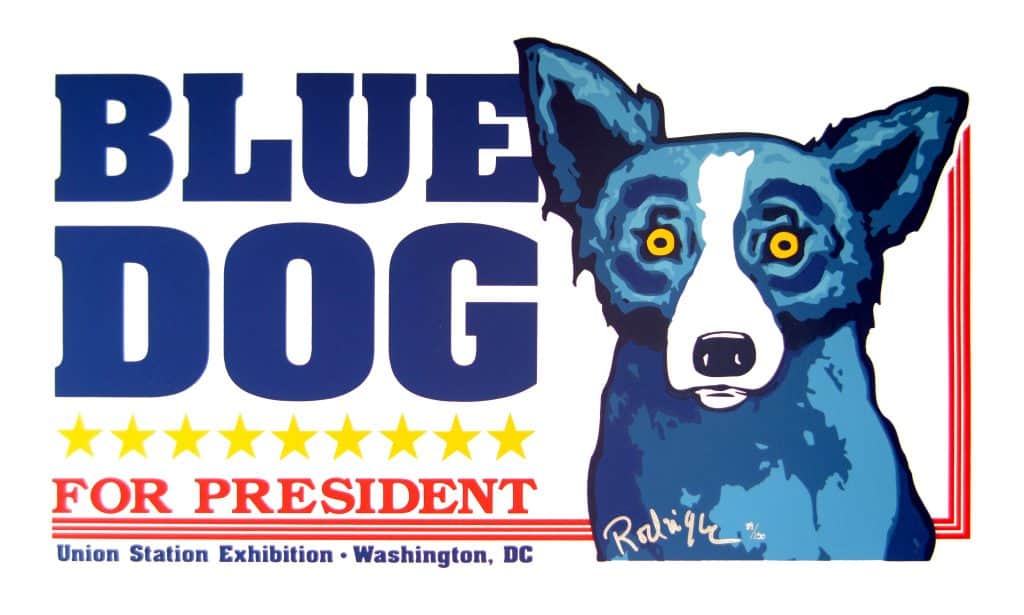
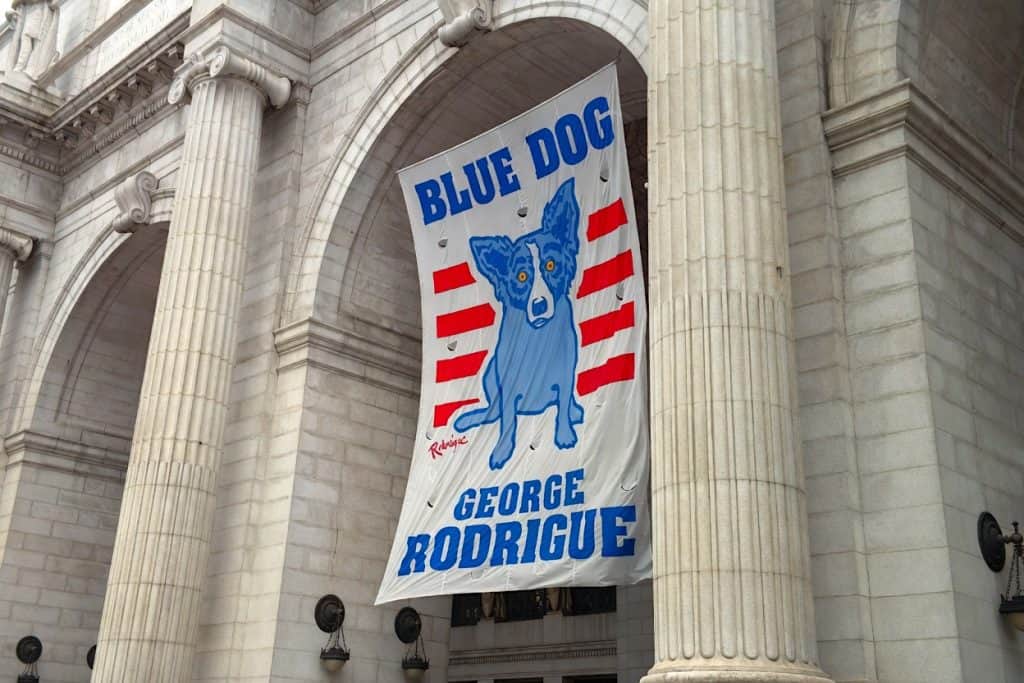
In 1996, during a presidential election year, Rodrigue presented the exhibition “Blue Dog for President” at Union Station in Washington, D.C. The installation gathered patriotic paintings spanning four decades, including red-white-and-blue designs from the Blue Dog series.
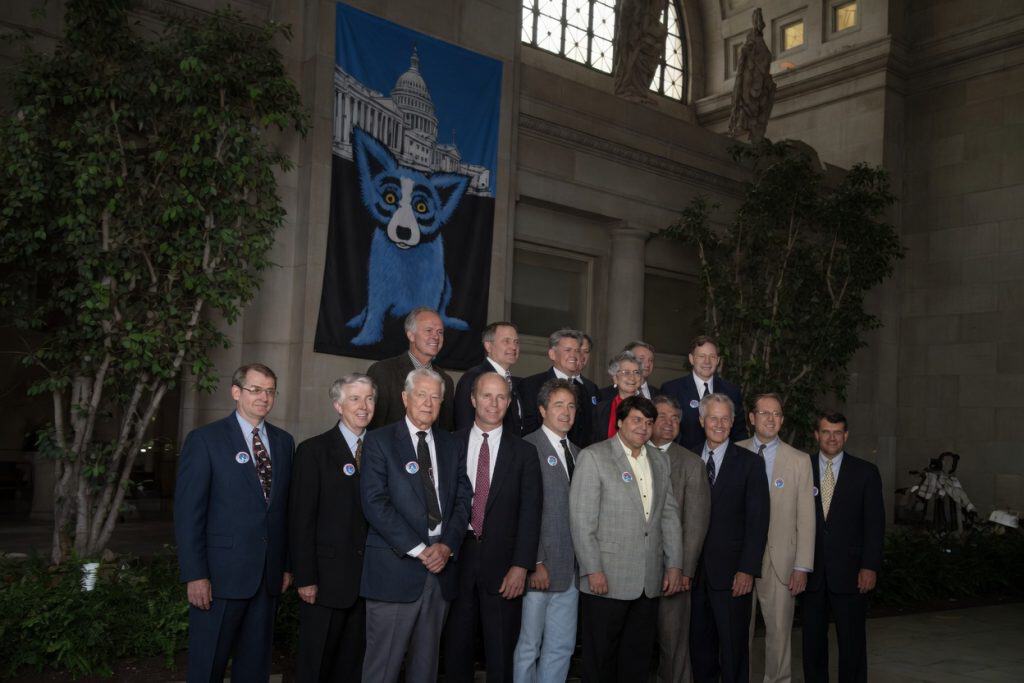
During the run of the exhibition, Rodrigue was photographed with members of the Blue Dog Coalition, a group of moderate, fiscally conservative Democrats in Congress who had formed in the mid-1990s. The lawmakers adopted the “Blue Dog” name in part because one of the coalition’s founders kept a Rodrigue painting in his Capitol Hill office, where the group often met. In a lighthearted moment that blurred the line between art and politics, the congressmen gathered around the artist and his iconic creation inside Union Station. The photograph captures the playful, cross-partisan spirit of the exhibition, as Rodrigue’s Blue Dog—originally a figure from Cajun folklore—briefly became a mascot for a real political faction in the nation’s capital.
Two decades later, in 2016, Rodrigue Studios in New Orleans recreated the spirit of that landmark exhibition with a major presentation titled Rodrigue: Blue Dog for President. The show brought together patriotic works spanning four decades and demonstrated that the Blue Dog’s connection to American civic life had only grown stronger with time.
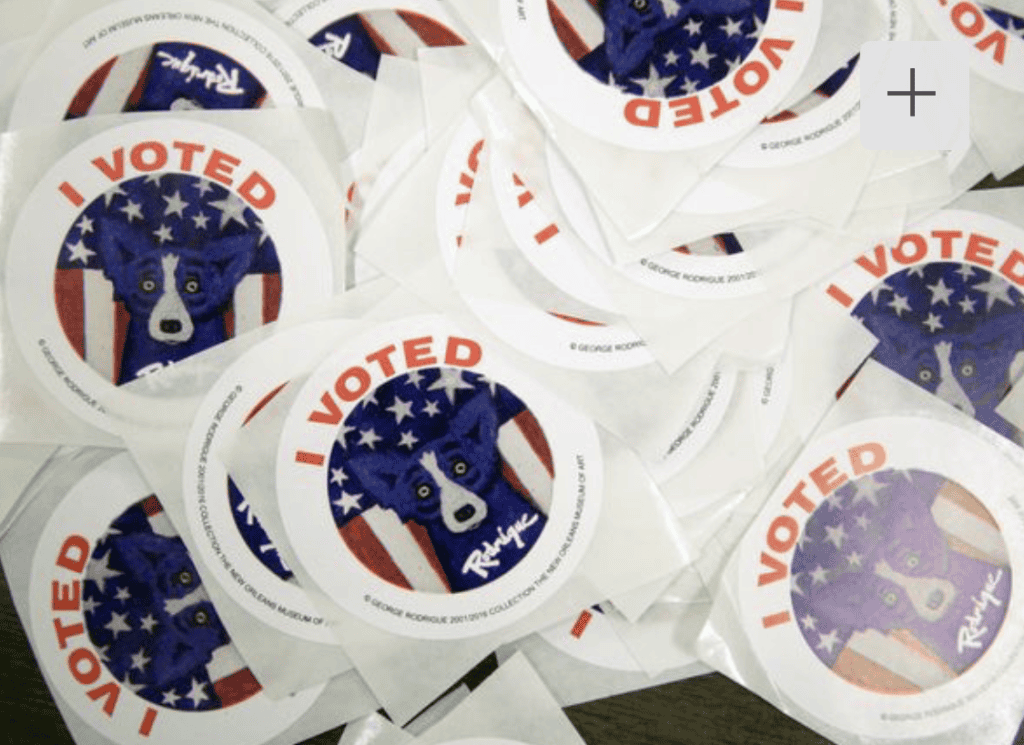
That same year, the state of Louisiana distributed over a million official “I Voted” stickers featuring Rodrigue’s Blue Dog. Unveiled in October 2016 by Secretary of State Tom Schedler, the stickers used the painting Stand Up Straight and Tall (2001), which shows the Blue Dog against an American flag. The initiative was deliberately timed to coincide with the twentieth anniversary of the original Blue Dog for President exhibition. By placing the Blue Dog on every polling place sticker across the state, Louisiana turned what began as a figure rooted in Cajun folklore into a statewide symbol of civic participation — a powerful affirmation of how far the Blue Dog had traveled from its Cajun origins into the heart of American democratic life.
In connection with the nation’s 250th anniversary, Rodrigue Studios has released a new print edition of Stars and Stripes and Me (1996). The acrylic-on-canvas painting, originally included in the Blue Dog for President exhibition, embodies the same patriotic spirit that runs through Rodrigue’s flag-motif works of the 1970s and his later Blue Dog compositions. Its release offers collectors a tangible expression of the artist’s lifelong engagement with American symbols.
The 2024 PBS documentary Blue: The Life and Art of George Rodrigue, which received the 2026 News & Documentary Emmy Award for Outstanding Regional Documentary, further illuminates these connections. As the film shows, by the mid-1990s Rodrigue’s work had secured a place in the broader conversation of American art—demonstrating how a visual language born in Louisiana had evolved into one of the most recognizable and enduring icons in contemporary American culture, much as earlier Regionalists had used local imagery to speak to questions of national identity and belonging.
Throughout his career, George Rodrigue followed a remarkably consistent artistic path. He began by documenting and celebrating a specific regional culture, then transformed that foundation into a visual language capable of speaking to the broader American experience. The Blue Dog, the presidential commissions, the Blue Dog for President exhibitions, and works such as Stars and Stripes and Me reflect that evolution—from preserving the traditions of Acadiana to creating one of the most recognizable icons in contemporary American art. As the United States celebrates its 250th anniversary, Rodrigue’s work reminds us that America’s most enduring cultural symbols often emerge from artists who remain deeply rooted in the places they call home.
For additional context on Rodrigue’s early Cajun paintings and the Blue Dog Series, see the related essay “Before the Blue Dog: The Cajuns of George Rodrigue and Their Relevance” or “Blue Dog: How a Cajun Legend Became a Pop Art Icon”