
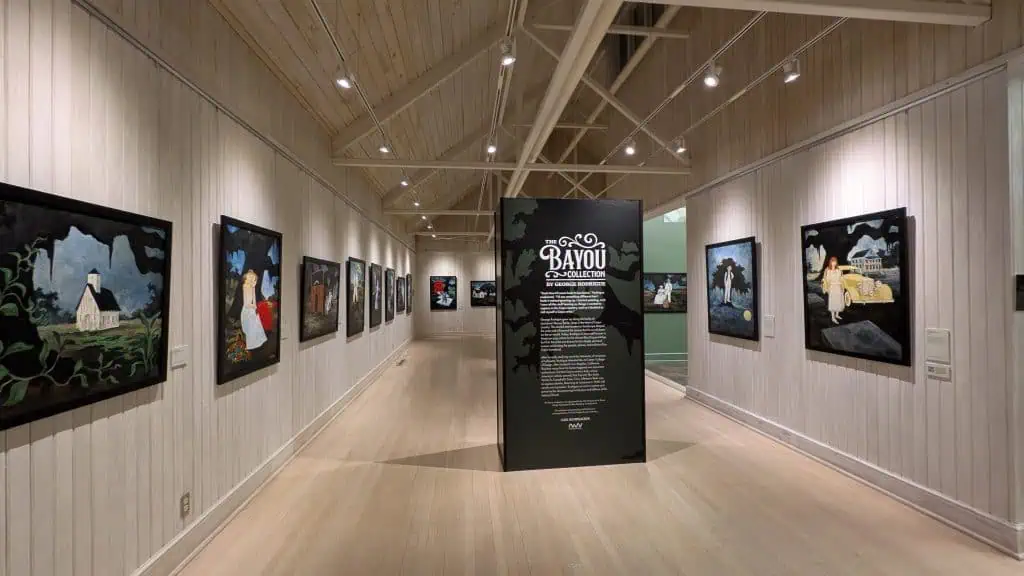
The Bayou Collection by George Rodrigue (1944-2013) is on view at the Walter Anderson Museum of Art in Ocean Springs, Mississippi (August 10, 2026–January 9, 2027). Organized by the LSU Museum of Art, the exhibition presents all forty of the collection’s original paintings created between 1981 and 1984 for the book, Bayou, by Chris Segura, published in conjunction with the 1984 World’s Fair in New Orleans.
This presentation of the Bayou Collection alongside the work of Walter Inglis Anderson (1903–1965) provides an opportunity to explore the parallels and connections between the two Louisiana born artists. Working a generation apart, both Anderson and Rodrigue built distinctive visual languages from the landscape, folklore, and cultural memory of their adjacent, Gulf South regions.
Rodrigue’s Path: From Cajun Preservation to Graphic Icon

George Rodrigue studied at the University of Southwestern Louisiana and the Art Center College of Design in Los Angeles. He returned to Louisiana determined to paint the Cajun culture he saw eroding. His early works—such as The Coulee (1969), Aioli Dinner (1971, pictured), and The Class of Marie Courregé (1972)—placed sharply defined figures dressed in white beneath the dark, enveloping branches of live oaks. The high horizon, flattened space, and deliberate contrast between people and landscape reflected both modernist design principles and a Regionalist impulse shared with artists like Grant Wood, Thomas Hart Benton, and Andrew Wyeth. Rodrigue called the style “Bayou Surrealism” or “Naive Surrealism”: local myth and history rendered with intentional clarity rather than folk naïveté.
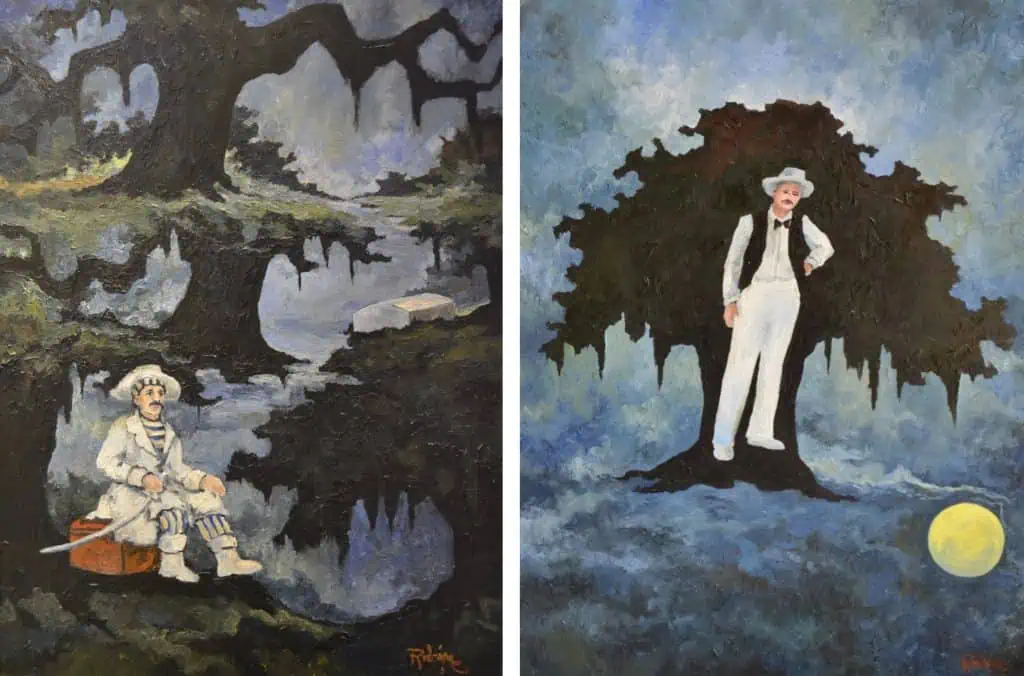
The Bayou Collection encapsulates Rodrigue’s Bayou Surrealism at its most concentrated. Each of the forty paintings answers a Cajun ghost story, but the images often go beyond illustration into dream logic. A Sea Chest of Secrets (1984) and Frontiers of Space (1983) are among the most striking examples. In the first, a white-clad figure—Pirate Jean Lafitte—sits at the edge of a dark bayou with a saber across his lap while a pale tomb-like form and the blending of river and sky collapse living pirate, grave, and empty night into a single space. The painting compresses three moments at once: Lafitte alive with his gold, his grave hiding the treasure beneath the same tree, and a sky emptied of both man and chest. In the second, a man in full white stands against a near-black oak with yellow moon beneath, less a person in a landscape than a spirit staged against a tree. Together the two canvases show why this series is among the most surreal of Rodrigue’s career: the signature oak and enclosing darkness remain, yet the white figures appear cut out and pasted into a world where folklore, death, and dream occupy the same plane.
One particular painting in the Bayou Collection represents a turning point in Rodrigue’s career.
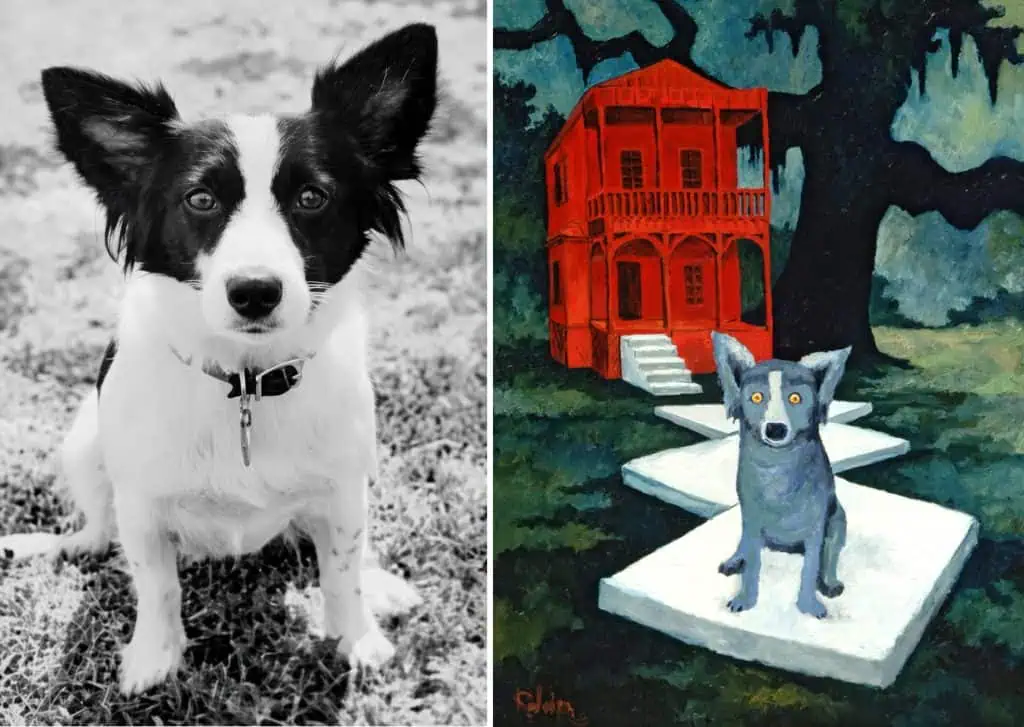
Watch Dog (1983) created for the story “Slaughter House,” features a depiction of the loup-garou, the Cajun werewolf haunting the swamps that Rodrigue and many other Cajun children grew up being warned about. In the painting, Rodrigue based the shape of the loup-garou on photographs of his late studio dog Tiffany. Painted under a bluish moon, the dog stands on white stone slabs leading to a blood-red house, an oak looming behind. Meant to be fearsome, the creature emerged frontal, curious, and strangely approachable.
That single painting began the Blue Dog series. Over the following decades Rodrigue represented the figure of the Blue Dog using Pop Art strategies including hard edges, saturated color, and repetition—while the yellow eyes continued to carry what he described as “the hopes and longings of a melancholy people.” The Bayou Collection is therefore not a commissioned detour but the moment when Rodrigue’s Regionalist foundation and his interest in the bold visual aspects of mid 20th century modern art began to cohere.
Anderson’s Approach: Realization and the Living Coast
Anderson studied art at the New York School of Fine and Applied Art (now Parsons School of Design) and the Pennsylvania Academy of the Fine Arts before returning to Ocean Springs to work as a designer at his family’s business, Shearwater Pottery. In Mississippi, Anderson spent long stretches of time alone on Horn Island, rowing out with provisions and painting on ordinary typing paper or, more rarely, in oil. He called his process “realization”—the revelation of an underlying order in nature through direct observation of birds, animals, light, and tides.
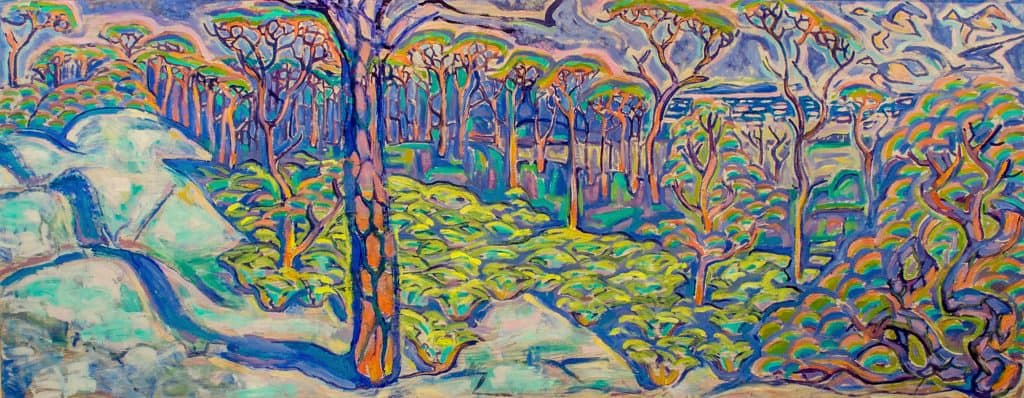 Image Courtesy of the Walter Anderson Museum of Art
A striking example of this mature vision is Horn Island (circa 1960), also known as Horn Island Oil, from the collection of the Family of Walter Anderson. In this horizontal landscape a pale, dune-like form and a winding blue-and-white path or stream lead the eye into a dense stand of trees. The trunks blaze orange and red with cool blue outlines; the canopies erupt in yellows, limes, and turquoise against a swirling blue sky. Color is heightened and almost un-naturalistic—what one contemporary called “otherworldly”—yet the forms remain grounded in the wind-shaped pines and scrub of the barrier island itself. Anderson treated these trees not as passive scenery but as living participants in a larger order. Through prolonged immersion on Horn Island he sought the moment when form, space, color, and feeling fuse so that the landscape becomes fully present.
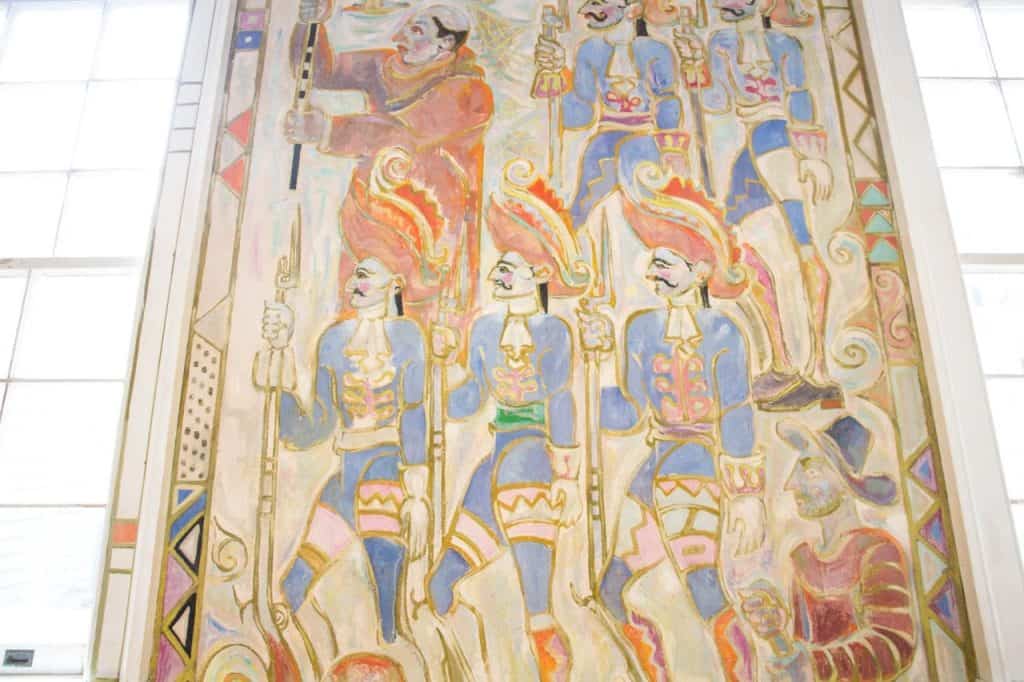 Image Courtesy of the Walter Anderson Museum of Art
His public masterwork is the Ocean Springs Community Center mural cycle of 1951–52, nearly two thousand square feet painted for a fee of one dollar. One wall depicts d’Iberville’s landing and the meeting of European and Indigenous histories.
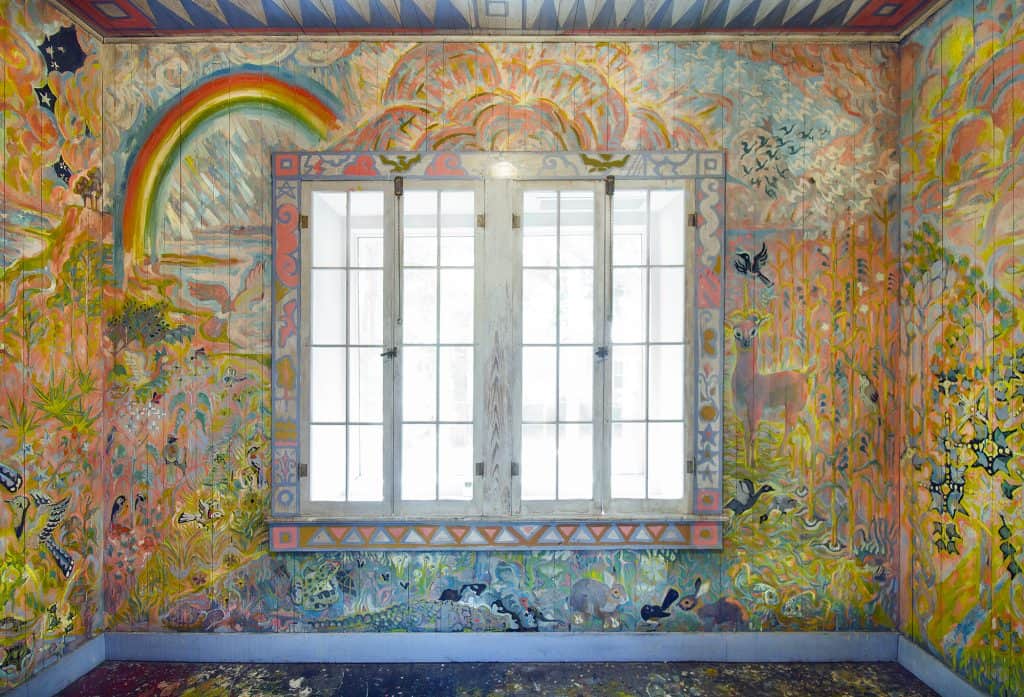 Image Courtesy of the Walter Anderson Museum of Art
The opposite wall, the “Seven Climates,” turns a single coastal day into cosmology. The private “Little Room” which was once part of Anderson’s home at Shearwater, continues the same hymn to light and place. Anderson’s linoleum block prints further clarify his approach: bold positive and negative space, repeated motifs, and a graphic clarity designed so that beauty could be accessible.
Trees as Carriers of Meaning
Rodrigue and Anderson’s approach to trees in their paintings highlight the points of connection and divergence amongst their work. For Rodrigue the live oaks grounded and shaped the visual architecture of his paintings. The limbs of the trees and hanging Spanish moss created interesting shapes in the paintings adding dimension to his depictions of the Cajun landscape.
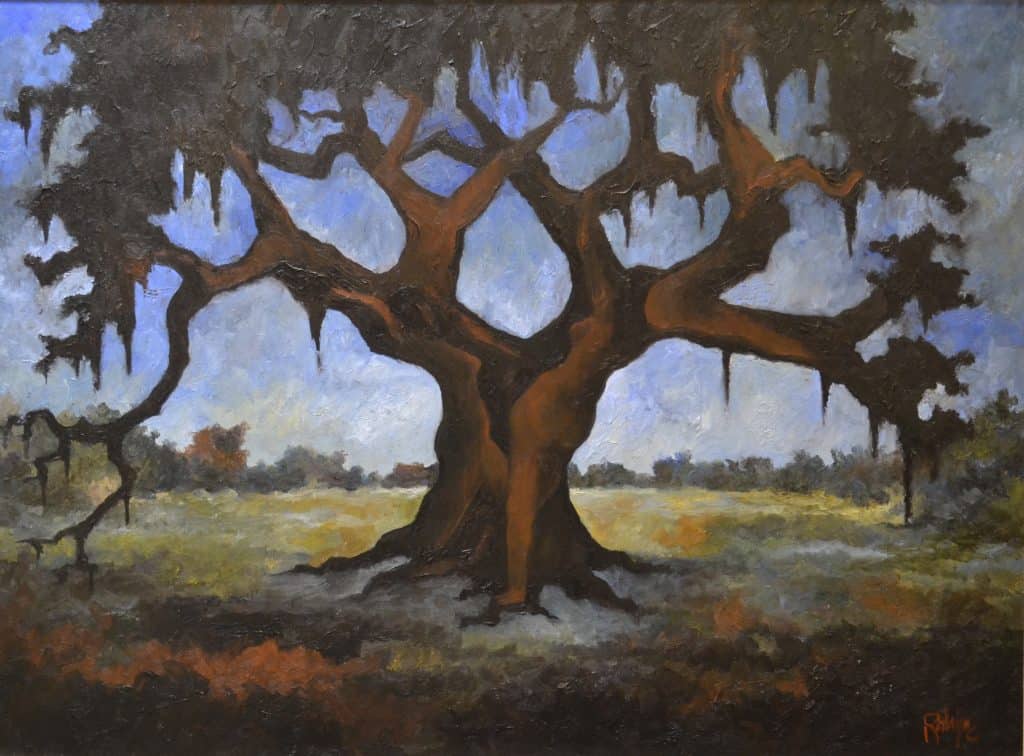
Rodrigue’s oaks do more than structure his compositions. They also set the scene for Cajun culture—legendary figures such as Jolie Blonde and Longfellow’s Evangeline, as well as the unnamed people he painted in the Louisiana landscape. In the Bayou Collection the oak heightens mystery. In Mystery of the Limbs (1983), faint female forms seem to emerge from the tree itself, suggested in the lighter brown of the trunk and twisting branches. The oak is no longer only a backdrop. It becomes the place where figure and landscape occupy the same body.
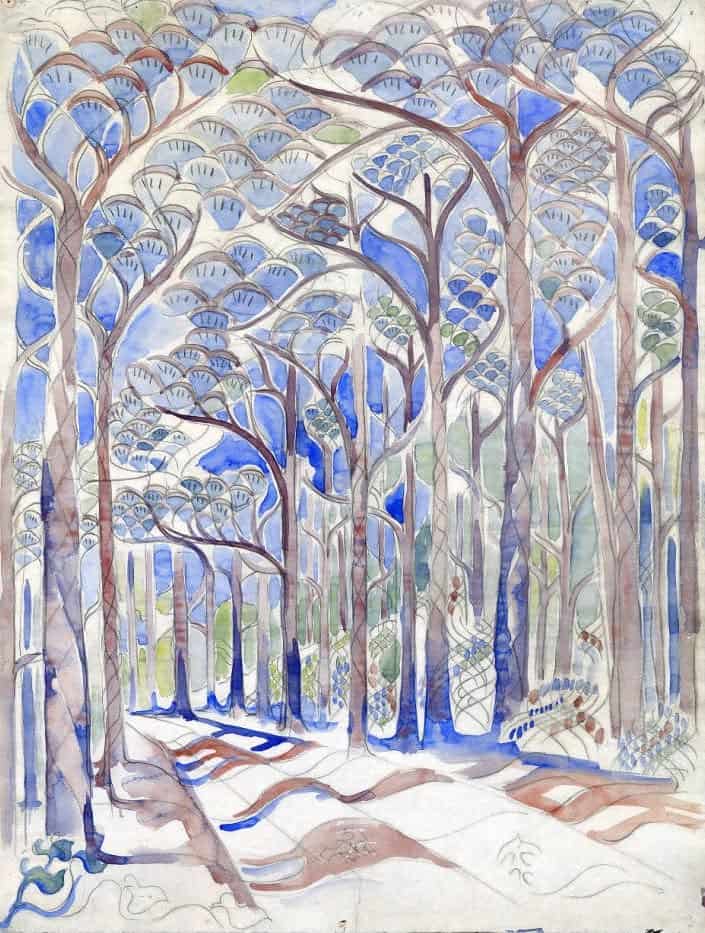 Image Courtesy of the Walter Anderson Museum of Art
Conversely, Anderson’s trees, like the ones depicted in Road to Oldfields (circa 1945) and related works are rhythmic, observational, and immersive. Color organizes emotion and form in these works and the trees help to reveal other aspects of the natural world like light, wind, and sky. Anderson’s trees capture the ethereal in nature as observed and translated through his process of “realization.”
And yet both Rodrigue and Anderson used trees in their work to express a human connection to the natural world. In Rodrigue’s case the connection exists between the Cajun people who after being exiled from other places finally made a home for themselves in Louisiana. In Anderson’s case the trees show what’s possible if you allow nature to speak to you over time. He writes,“True art consists of spreading wide the intervals so that imagination may fill the space between the trees.”
Why Both Belong in the American Canon
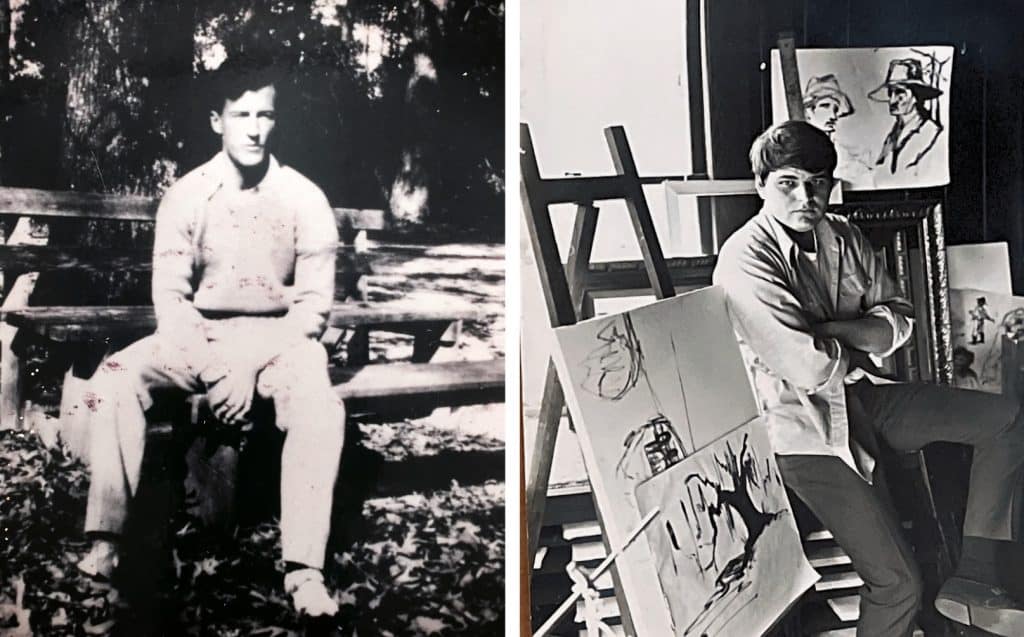 Left, Walter Anderson, c. 1930, Right, George Rodrigue, c. 1969
American art history has long recognized the importance of Regionalists, artists who through their committed vision showed us the diverse beauty of this country. But, unfortunately Regional painters working in the Gulf South aren’t always included in conversations about American Regionalism more generally.
Contributions to the genre made by artists like Anderson and Rodrigue can go overlooked. Anderson’s artistic achievements may get overshadowed by his eccentricities and mental health struggles. And similarly, Rodrigue’s regional perspective may go under-appreciated because the popular success of the Blue Dog came to stand in for the whole career. But both artists used their immense knowledge of art history and unique talents to create work that has enriched our visual understanding of the Gulf South.
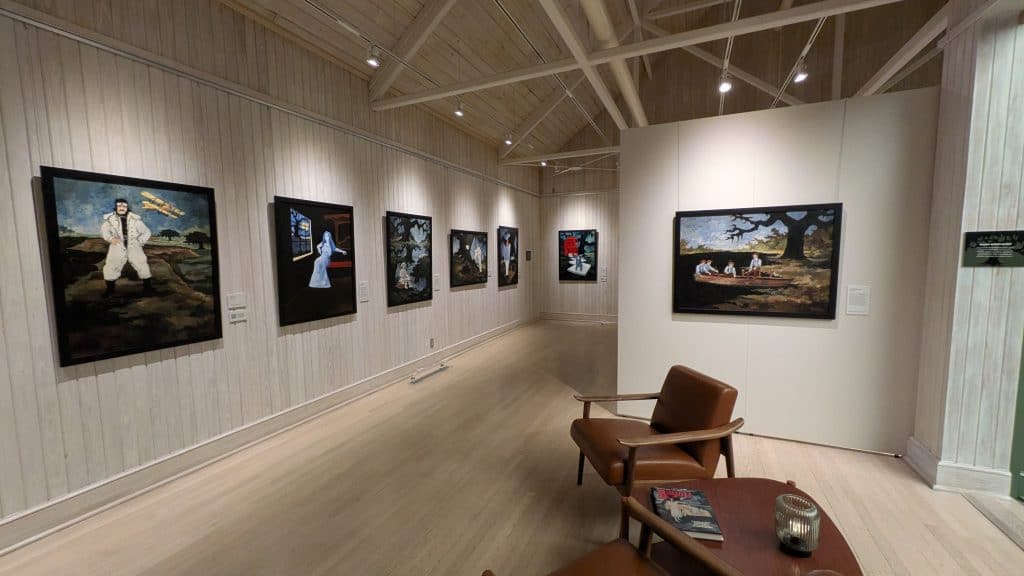
Seeing the complete Bayou Collection—with its dark, narrative oak-framed scenes and the first Blue Dog—alongside Walter Anderson’s work, makes the points of connection in their approach to creativity visible. One artist painted Louisiana’s bayous as a haunted theater of cultural memory. The other painted the Mississippi coast as a living cosmology of light, tide, and creature. Both applied rigorous formal training to subjects and areas occasionally overlooked by the broader art world. Both produced large, consistent, and formally sophisticated bodies of work that treat the Gulf Coast landscape and its folklore as worthy of the same serious attention given to other American regional traditions.
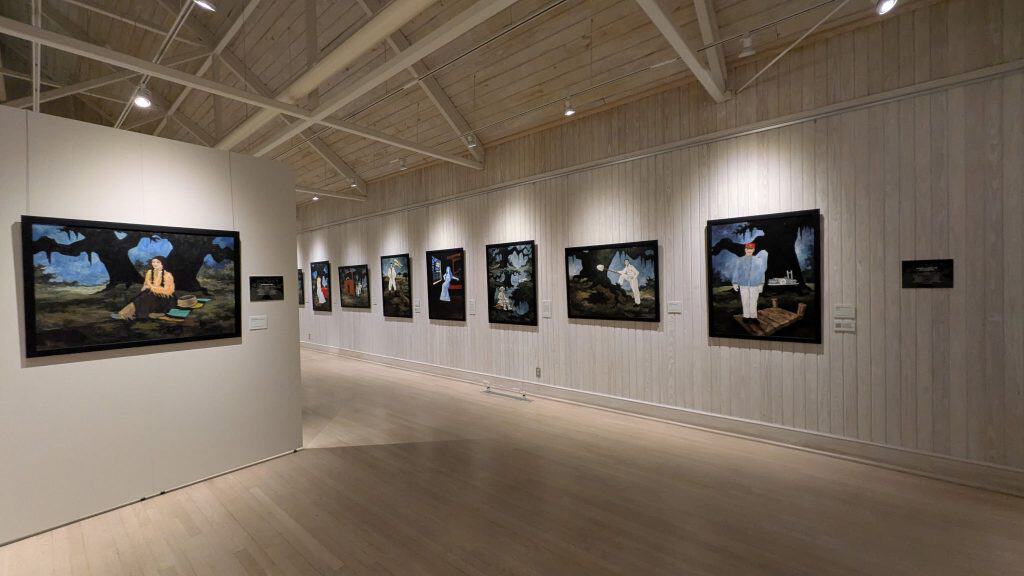
As Mattie Codling, Executive Director of the Walter Anderson Museum, has noted, the pairing brings together two symbols of Southern storytelling—Rodrigue for Louisiana, Anderson for Mississippi—looking at the same Gulf South landscape from different but complementary perspectives. They are not only regional emblems. They are American artists who used the particular—oak and pine, loup-garou and dune, World’s Fair commission and solitary island sojourn—to ask what belonging looks like when the ground itself is water, memory, and myth.
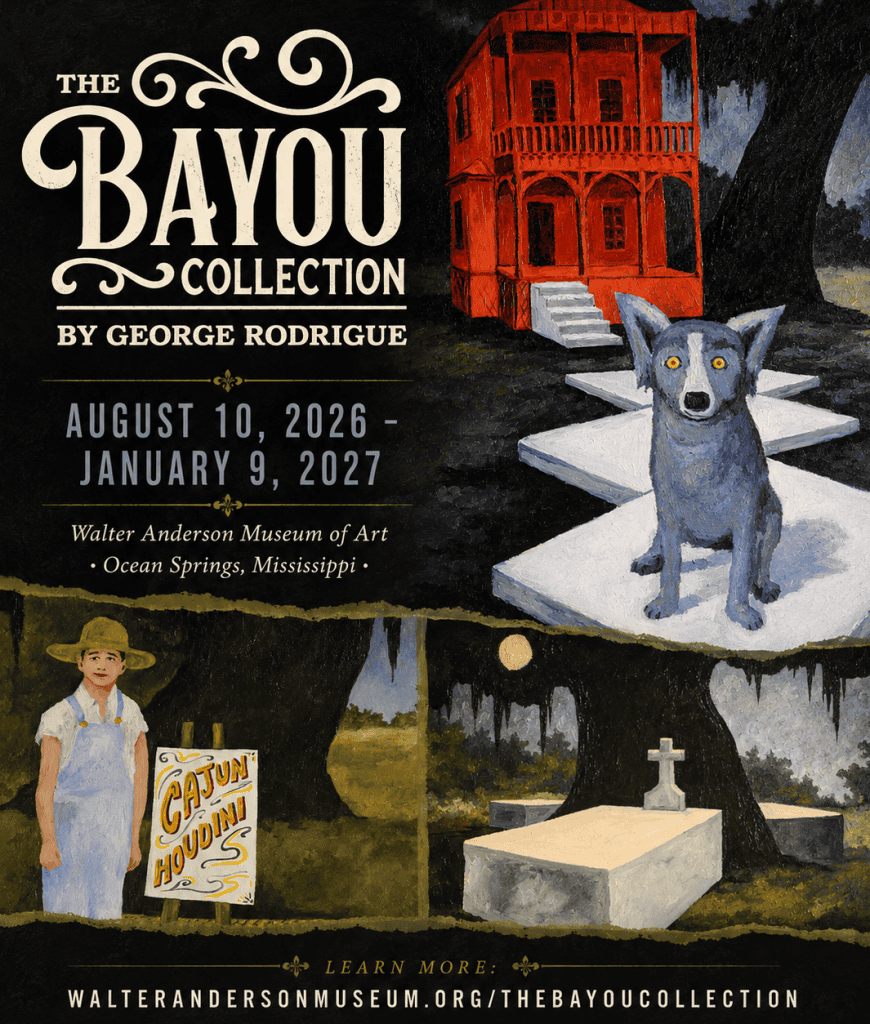
The Bayou Collection by George Rodrigue remains on view at the Walter Anderson Museum of Art, 510 Washington Avenue, Ocean Springs, Mississippi, through January 9, 2027. The exhibition was organized by the LSU Museum of Art; works © George Godfrey Rodrigue, Jr. Family Trust. Anderson’s Horn Island (circa 1960) and related works from the permanent collection and family holdings provide the luminous observational counterpoint that deepens the conversation.
For more context on Rodrigue’s early Cajun paintings and the evolution of the Blue Dog, see the related essays “Before the Blue Dog: The Cajuns of George Rodrigue and Their Relevance” and “Blue Dog: How a Cajun Legend Became a Pop Icon.”