In 1996, George Rodrigue created a series of five monumental Blue Dog works, each measuring 14 feet high by 8 feet wide. Painted in acrylic on vinyl, the banners were installed in the interior of Union Station in Washington, D.C., for Rodrigue’s Blue Dog for President exhibition. Created during a presidential election year, the works welcomed visitors into a show of patriotic-themed Blue Dog paintings. (pictured George Rodrigue with banners, 1996)
Of the five banners, one entered the permanent collection of the LSU Museum of Art, two remain in the Rodrigue Family Trust, and two were acquired by Texas businessman and major Rodrigue collector Don Sanders. Rodrigue Studios is now pleased to offer these two works from the Sanders collection — the largest Rodrigue paintings ever to come to market.
Due to their scale, Rodrigue painted the series in an industrial warehouse rather than his studio. Working with rich, visible brushstrokes, he enlarged the Blue Dog to a size that underscores its transformation from the Cajun loup-garou into a powerful graphic symbol, emphasizing the dog’s distinctive shape and intense yellow eyes.
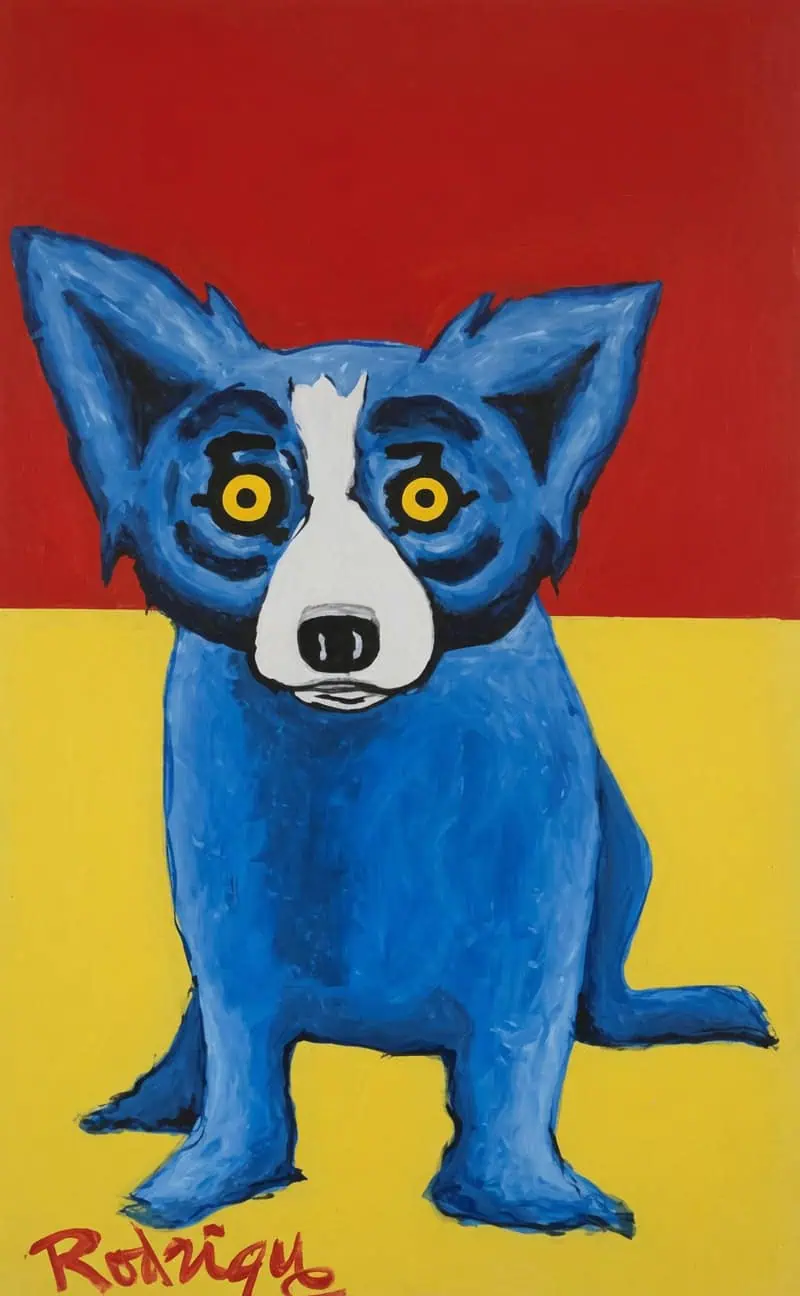
In one of the available works, the Blue Dog stands against a color-blocked background of red and yellow. Through this bold use of primary colors, Rodrigue reduces the composition to its essential elements: the dog’s silhouette, its captivating yellow eyes, and the saturated color fields.
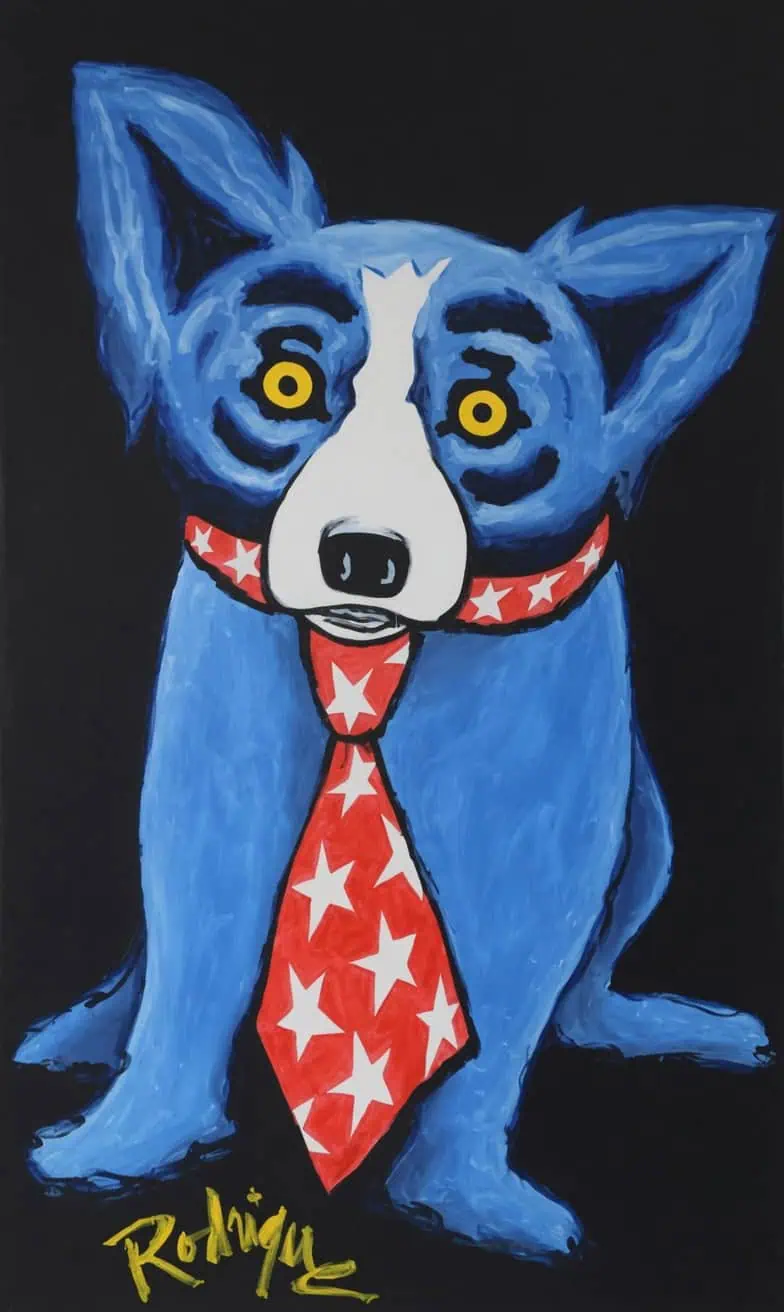
In the second banner, the Blue Dog appears against a black background wearing a red necktie patterned with white stars. The tie directly references both presidential campaign imagery and the American flag, connecting the work more explicitly to the 1996 exhibition’s concept.
On the occasion of the nation’s 250th anniversary, Rodrigue Studios presents these banners as a recognition of George Rodrigue’s contribution to America’s visual language through enduring cultural symbols such as the Blue Dog. Beginning in August, the two works will be on view for the first time in New Orleans at the artist’s flagship gallery on Royal Street.

In 1996, George Rodrigue created a series of five monumental Blue Dog works, each measuring 14 feet high by 8 feet wide. Painted in acrylic on vinyl, the banners were installed in the interior of Union Station in Washington, D.C., for Rodrigue’s Blue Dog for President exhibition. Created during a presidential election year, the works welcomed visitors into a show of patriotic-themed Blue Dog paintings. (pictured George Rodrigue with banners, 1996)
Of the five banners, one entered the permanent collection of the LSU Museum of Art, two remain in the Rodrigue Family Trust, and two were acquired by Texas businessman and major Rodrigue collector Don Sanders. Rodrigue Studios is now pleased to offer these two works from the Sanders collection — the largest Rodrigue paintings ever to come to market.
Due to their scale, Rodrigue painted the series in an industrial warehouse rather than his studio. Working with rich, visible brushstrokes, he enlarged the Blue Dog to a size that underscores its transformation from the Cajun loup-garou into a powerful graphic symbol, emphasizing the dog’s distinctive shape and intense yellow eyes.
In one of the available works, the Blue Dog stands against a color-blocked background of red and yellow. Through this bold use of primary colors, Rodrigue reduces the composition to its essential elements: the dog’s silhouette, its captivating yellow eyes, and the saturated color fields.
In the second banner, the Blue Dog appears against a black background wearing a red necktie patterned with white stars. The tie directly references both presidential campaign imagery and the American flag, connecting the work more explicitly to the 1996 exhibition’s concept.
On the occasion of the nation’s 250th anniversary, Rodrigue Studios presents these banners as a recognition of George Rodrigue’s contribution to America’s visual language through enduring cultural symbols such as the Blue Dog. Beginning in August, the two works will be on view for the first time in New Orleans at the artist’s flagship gallery on Royal Street.